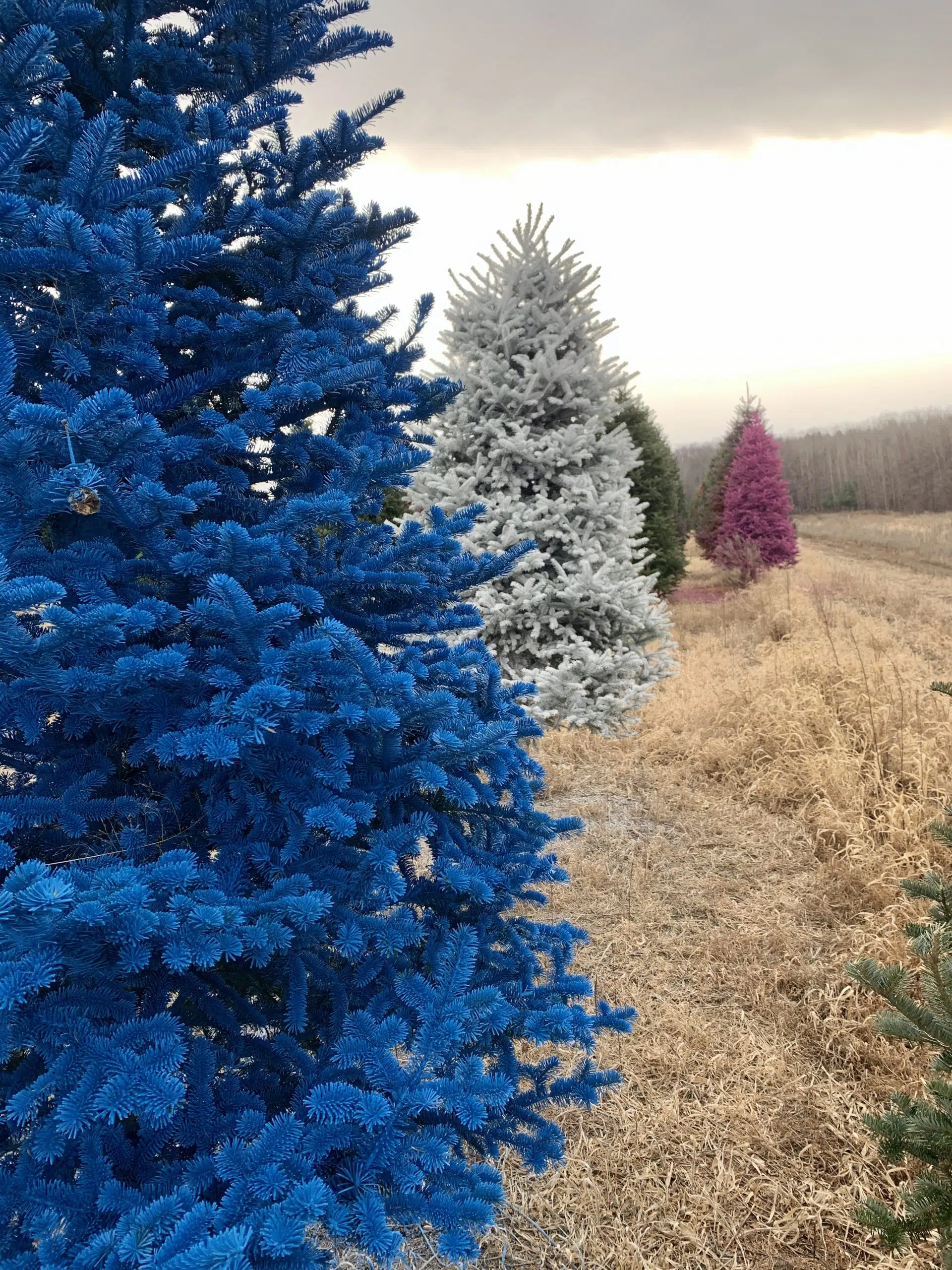
This is a big weekend for Wisconsin’s Christmas tree industry. Most people barely recover from their Thanksgiving food coma before trying to put up the Christmas tree and move onto the next holiday. Lucky for Christmas fanatics, tree farms in the state fully embrace this. In fact, Mary Kunasch of Happ’s Tree Farm in Mt Morris said that the weekend after Thanksgiving, along with the following weekend are the busiest ones they have. Kunasch mentioned that she’s ready for the flood of people, she loves this place. “This is a great job. I love it every day out here and when it snows, it’s just gorgeous,” Kunasch said.
She was explaining to me how Waushara County used to be one of the biggest Christmas tree producers in the entire country. One reason that put them on the map was their sandy soil, but another one being the Kirk Company. Kirk Company is a Christmas tree grower that also sells a lot of tree supplies like environmentally friendly paint for the trees. They started to put down roots in Wautoma in the early 1950s, which became one of their three nationwide branches. Kunasch said that back when she was about 14-years-old the company owned thousands of acres of Scotch pine trees because that was in demand, but things have changed.

Tom Happersett is the owner of Happ’s Tree Farm and he started getting into the tree industry when he was around the same age as Kunash. “I started out then when I was 15 and I worked for a gentleman named Ronnie Campbell. He owned Campbell Tree & Land Company in Wautoma…he was a great teacher…in 1988 he died of a plane crash right here in Wautoma. So I stayed with the company for nine more years and I decided to branch out on my own,” Happersett said.
Unlike the tree farms back in the day that had Scotch pines, Happ’s Tree Farm grows Fraiser Firs which a lot of people questioned. Happersett explained that people wondered why he wanted to raise Fraiser Firs because they’re normally grown in North Carolina and they were thought to need altitude to grow. After some trial and error, they figured out a way to make it work here in Wisconsin. He said that in the state, we don’t have as many issues with the Fraiser’s because they’re new to our area so we don’t have disease problems like they do in North Carolina. That doesn’t mean that the tree is without issues.

“What happens to this tree is, a lot of people think that it dies from a drought, but it really doesn’t,” Happersett went on the say, “What happens is the soil temperature gets so high and they can’t tolerate it. So it cooks the roots right in the ground because that is a mountain tree and they’re used to being cool.”
Kunasch was talking about the busy season and how on average they normally get about 700 families that come to the farm from the weekend that they open up until the weekend they close which is about a one month span. Back in 2013, she was one of two helpers that ran the lot and now they’ve grown that to about eight employees besides herself. She mentioned how working on a tree farm can really teach people a lot. “I hired two 14-year-olds this year to work out here. They need to know how to work. They need to know how to do customer service, how to greet your people, how to be kind, and how to just work. It’s everything, it’s the whole package,” Kunasch said.

Happersett brought up how running a tree farm is more than what people think it is. “I go through horrible things. I mean it’s like going to war. When I start harvesting trees, it don’t matter it can be raining, pouring, we got to get these trees out,” he said. He talked about how his old boss used to say that “Christmas doesn’t wait for anybody.” He said that he definitely feels the pressure, not only during the busy season, but year round because you’re trying to grow the perfect tree. Happersett compared it to being an artist, “you’re always trying to get the perfect portrait and do whatever it takes to make it work.” Even with all of the challenges facing Christmas tree farmers like Happersett, the perk is that they do get some time off before spring. He uses his time off to travel in his RV and go wherever he wants.
Happersett said that one of the keys to running a Christmas tree farm is timing. “Everything is timing. You have to do things on time, that’s the biggest thing with this. You have to herbicide, which is kill the weeds. Then you have to fertilize…after that, shearing, and after that it’s tagging the tree, selecting the trees that are going to make Christmas trees that people are going to buy.” He also said that if someone was interested in running a tree farm, it wouldn’t be a bad idea at this point. “They could really make a nice living out of this,” Happersett said. He explained that the business is in high demand and that he gets calls from people who want trees all of the time. So if you’re looking to switch things up a bit, maybe you could look into being a Christmas tree farmer.

Happ’s Tree Farm is now open for the season every Thursday – Sunday!